4 min readUpdated
369 Method App vs. a Journal
Any of them work. They fail in different places — and knowing which failure is yours is the whole decision.
Paper
Paper is the traditional format, and handwriting is harder to do on autopilot than typing. The cost is portability — the afternoon round often falls when the notebook is at home. Dedicated 369 journals are mostly pre-printed grids; for an honest look at what you're buying, see /guides/369-method-journals-and-books. A free printable does the same grid job: /guides/369-method-pdf-template.
Where paper fails most often is the middle of the day — on a train, in a queue, at a desk — precisely when the streak is most likely to break.
Notes app
Always with you, which solves the afternoon problem. The costs are real though: typing is fast enough to be thoughtless, copy-paste is one gesture away, nothing reminds you, and nothing counts. Within two weeks most people can't say what day of the cycle they're on.
A guided practice
An app built for the method solves the three specific things that kill cycles — the forgotten afternoon round, the lost count, and the autopilot.
If you're evaluating one, the features that matter are narrow:
- Reminders for all three slots — especially the middle one.
- Stages that unlock in order, so 3 · 6 · 9 stays a sequence rather than a suggestion.
- A count you don't have to keep yourself.
- Both spoken and written modes — hold-to-speak out loud, or write when you can't.
- Your words kept private and on your device.
Spoken or written — both work in Shyne
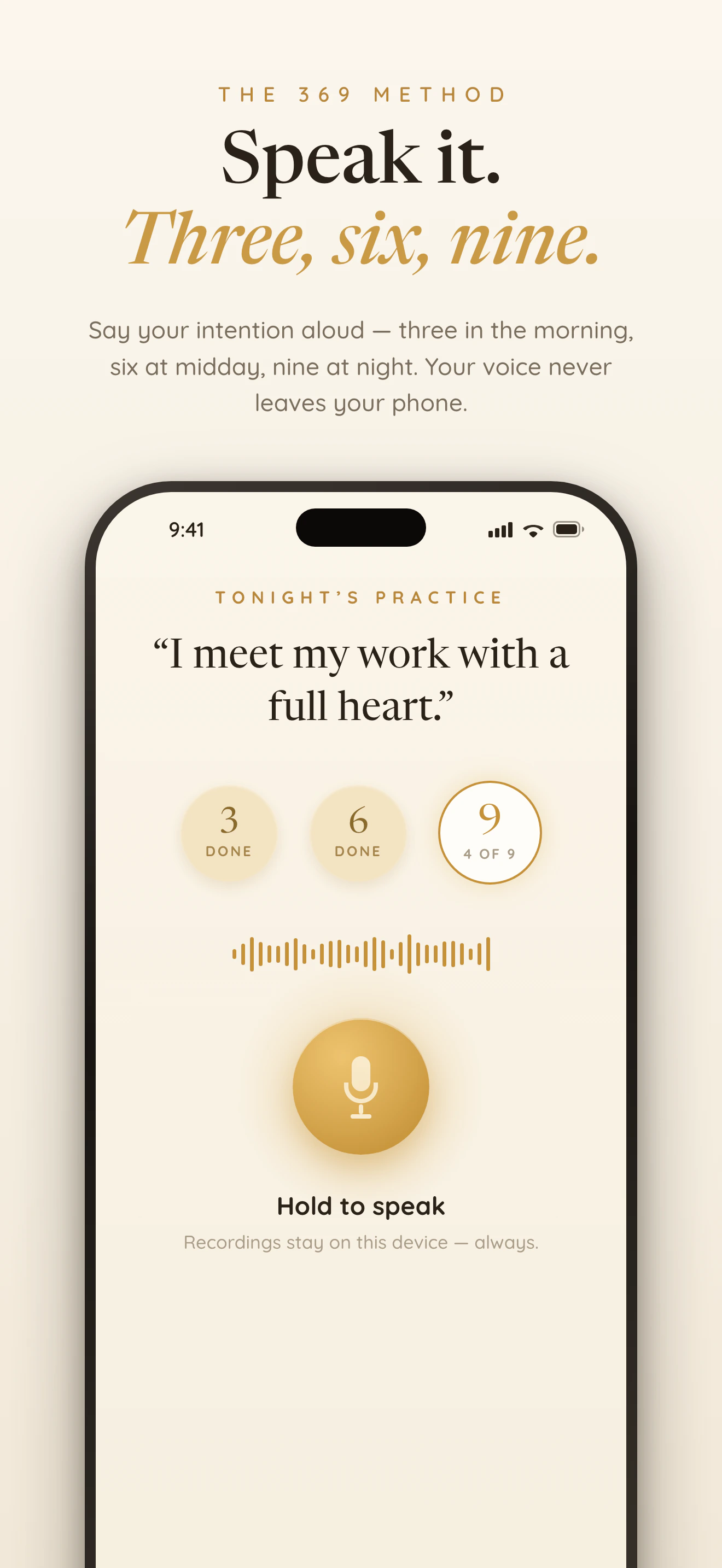
The 369 method can be done by voice or on the page. Shyne supports both: hold to speak your intention out loud and the app recognises each repetition, or switch to written mode with an ink picker when speaking isn't possible. Same 3 · 6 · 9 stages either way.
Speaking is often the stronger default — hearing your own voice claim something is harder to tune out than copying a line — but the written mode means you never skip a round because you're on a quiet train or in an open office.
Practising 369 in Shyne
Shyne is a daily manifestation app for iOS with the 369 method built in as a guided practice. You set one intention, then move through the three stages in a day — hold to speak your intention aloud and the app listens for each repetition, or switch to written mode when you can't speak. Stages unlock in order, the count is kept for you, and you can set reminders for all three slots.
Spoken repetitions are recorded so you can listen back the same day; those recordings stay on your device and are never uploaded. Around the 369 practice sit the rest of a daily ritual — a mood check-in, a gratitude journal, curated affirmations, and a room of ambient sounds.
Practise it in the app
Shyne — 369 Method & daily manifestation
Guided 3 · 6 · 9 stages, spoken or written, with the count kept for you.
Common questions
- Is there an app for the 369 method?
- Yes — Shyne is an iOS app with a guided 369 practice: three stages that unlock in order, spoken or written repetitions (hold-to-speak or write), an automatic count, and reminders for all three daily slots.
- Can you do the 369 method by voice or only by writing?
- Either. Writing is traditional; speaking out loud is a recognised variation. In Shyne you can hold to speak each repetition, or use written mode with an ink picker — same stages, same count.
- Is it better to write the 369 method by hand or use an app?
- Handwriting is harder to do on autopilot; an app is with you for the afternoon round, keeps the count, and reminds you. Most broken streaks come from the missed afternoon round, which is the problem an app actually solves.
- Can you do the 369 method out loud instead of writing?
- Yes. Speaking it is a recognised variation and is often more effective than writing, because hearing yourself claim something is harder to tune out than copying a line onto a page. Shyne is built around hold-to-speak, with written mode as the alternative.
Keep reading